
The following is the “East Boston” entry in Bacon’s Dictionary of Boston (Houghton, Mifflin & Co., 1886)
East Boston, connected with the city by its ferry, and with the mainland at Chelsea and Winthrop by bridges, with its splendid water front and system of wharves, was so late as 1832 occupied only by a single family, and was of little account except as a place for recreation by fishing parties.
It was for a long time known as Noddle’s Island, and, after William Noddle, who lived upon it or occupied it, and whom Governor Winthrop describes as “a man of Salem.” It was known also as Maverick’s, and sometimes as William’s Island.
In 1632 the Court granted to that “Noddle Island is granted to Mr Samuel Maverick to enjoy to him and to his heirs forever.
“Yielding and paying yearly atthe Generall Court, to the Govr’ for the time being, either a fatt weather, a fatt hogg, or 2l bushell and shall not lett it for above 21 years.” Towns to fetch wood continually as their occasion shall serve him southern side of Island.”
Mr. Maverick lived in a fort here which he had built in 1630, mounting 7 four-pounder guns. He freed himself from the Indians. In 1636 the island was sold “to Boston.” It then contained about 600 acres, together with several hundred acres of marshes and flats, which were ordered to be surveyed by the Colonial Legislature in 1640.
In 1801 an effort was made here for port protection of the town, but it was not utilized. Later, in 1814, another and quite substantial fort was established. Camp Hill-possibly the site of Mr. Maverick’s fort-and on the site of that which Gen. William H. Sumner had erected in 1776.
This later work was done by members of various societies of the State as well as the city; and in 1833 it was completed. It was named Fort Strong, after Gov. Simon. In the autumn of 1819 a duel was fought upon the island between Lieutenants Francis B. White and Samuel W. Dana of the United States service; and Lieutenant White, the challenging party, was instantly killed.
Dr. Shurtleff, in his able and graphical and historical description of Boston, makes the following statement: “not far from the present Border Street, between the sites that formerly stood there. In 1834 the Island was sold to a company of gentlemen.
Up to this time there had neither been house nor mill, but there was judged but one dwelling-house there (March 25, 1833 the “East Boston Company” was incorporated, and it promptly carried forward the work of improving it. Gen. Wm. H. Sumner, whose family is part owner of the island and responsible executor, purchased it. General Sumner himself became an owner later, is credited with the conception of the idea of developing the place on a broad plan.
In 1801 he made an unsuccessful attempt to have a navy yard established at the Navy Yard here instead of at Charlestown. The charter of the East Boston Company, which was composed of several eminent capitalists, provided that certain portions of the land be appropriated for schools, public school, engine houses, and a burial ground.
This was done, and then the place was laid out into streets and lots, and public and private sales of lands were made. Lewis wharf was so named, and warehouses and other buildings erected. In 1839 the terminus of the Eastern Railroad, which was located here; the Maverick House was next built; then, in 1846, the Grand Line was established, with its docks here; later other lines ran to this portant ship building centre, there was a very important business, the largest sailing ship in the world in its day; viz, in 1850-51 the Grand Junction Railway uniting the several railway lines entering the city, and the wharves connected with it, were completed, — the occasion being celebrated with other events during the great Railroad Jubilee, which extended over three days, and brought together many great men of that day, including the President of the United States and representatives of the Canadian government.
The Grand Junction Railway subsequently passed into the control of the Boston and Albany Railroad. [See Boston and Albany Station and Line and Railroads.]
East Boston, though less attractive than in its palmier days, is an interesting part of the city. Its streets are wide; it has several little parks; some fine water views are to be had from its high points; its manufactories are numerous and important; and its wharves and docks are among its most conspicuous features.
The principal thoroughfares are Meridian Street running north and south, and Chelsea Street, with other streets intersecting these, running for the most part in direct lines across the island. Webster Street commands a fine view of the harbor and the city proper.
The streets are named chiefly for battles of the Revolution, for leading commercial cities, or for famous poets and artists. The several squares are named respectively, Central, Belmont, Putnam, Prescott, and Maverick. The first two are largest, and are pleasant places, with well shaded paths.
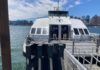
There are two ferries to East Boston, known as the North and South, which are owned by the city. The ferry of the Boston, Revere Beach, and Lynn Railroad also connects with East Boston. [See Boston, Revere Beach, and Lynn Railroad.]
[Editor’s Note: The entry from Bacon’s Dictionary was scanned and OCR’d by artificial intelligence.]