

Audits show Legislature carries heavy budget cushions
By Colin Young
State House News Service
Nov. 12, 2026…..The latest audits of the Legislature’s finances are available, revealing some basic financial information and little else amid heightened public interest in the inner workings of the House and Senate.
Fiscal year 2025 audits for the House, Senate and joint legislative accounts were posted to the Legislature’s website quietly in recent weeks, close on the heels of fiscal 2024 audits that were finalized in July.
The documents provide a basic accounting of money in and money out, reporting how much each branch had available, how much it spent and how much it carried forward into the new year (a power not available to most parts of state government). There’s no breakdown of what the money was spent on, nothing per member or per office, and the financial-statement audits differ from the type of performance audit that Auditor Diana DiZoglio and the Legislature have been at odds over for years.
The House, which has 160 members, entered fiscal year 2025 on July 1, 2024 with about $67.85 million available to it — an annual appropriation of $55.6 million plus $12.24 million carried over from fiscal 2024. The House spent $57.54 million by June 30, 2025, and carried $10.3 million into fiscal 2026.
The 40-member Senate had almost $50.46 million at its disposal when fiscal 2025 started — an appropriation of nearly $29.27 million plus $21.21 million carried in from fiscal 2024. The Senate spent $30.78 million in fiscal 2025, carrying $19.68 million into the new budget year when fiscal 2025 ended.
Both chambers spent more than they appropriated for themselves in fiscal 2025 and drew down their reserves; the House by $1.93 million and the Senate by $1.52 million, the documents show.
The story was reversed in the audit of joint legislative accounts. The shared books started fiscal 2025 with $19.68 million carried over from fiscal 2024, plus an annual appropriation of $10.7 million. The joint accounts spent about $8.5 million in fiscal 2025, leaving nearly $21.9 million for the House and Senate to jointly carry into fiscal 2026.
The audits were conducted by accounting and wealth management firm CliftonLarsonAllen LLP, the same firm that has audited the House, Senate and joint accounts since at least fiscal 2017, giving each a “clean” opinion each time.
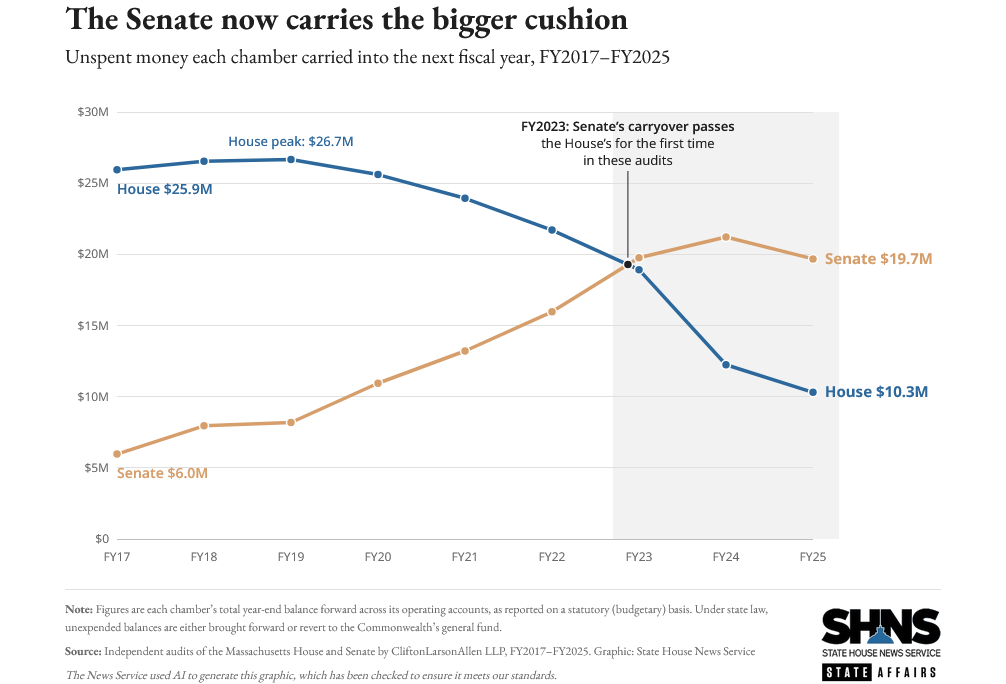
The Legislature’s website maintains copies of House and Senate audits going back to fiscal 2017, and of joint account audits back to fiscal 2021. Analysis of nine years of House and Senate audits and five years of joint audits paints the picture of how the Legislature manages its money — and shows that the House has been steadily spending down its cushion of unspent money, while the Senate and the joint accounts have been growing theirs.
When fiscal 2019 ended, the House had $26.7 million in unspent funds to carry forward. Starting in fiscal 2020, it spent more than its annual appropriation every year and used its carryover reserve to make up the difference. By the end of fiscal 2025, the balance stood at $10.3 million, a 61% drop. The steepest decline came in fiscal 2024, when the House spent $6.7 million more than it was appropriated.
Over the course of the nine years, House spending increased 54%, from $37.4 million in fiscal 2017 to $57.5 million in fiscal 2025. Senate spending grew faster, rising 66%, from $18.5 million to $30.8 million. During the same time, state budget spending increased about 65%, from $41.2 billion in fiscal 2017 to $68.1 billion in fiscal 2025, according to the comptroller’s office.
The Senate generally spends a little more than half of what the House does, yet it now maintains nearly twice as much in reserve.
From fiscal 2017 through fiscal 2024, the Senate spent less than its appropriation every year. Its carry-forward amount grew from $4.8 million to $21.2 million during that time. Fiscal 2025 marked the first drawdown, a year in which Senate spending jumped 10.7% against a flat appropriation.
The joint accounts, which fund shared legislative operations, have accumulated money faster than either branch. The joint accounts spent between 62% and 79% of the annual appropriation in each of the five years for which audits were available. The carry-forward amount more than tripled — from $6.5 million entering fiscal 2021 to $21.9 million at the end of fiscal 2025. That’s enough to cover about two and a half years of joint spending.
The audits themselves have become available to the public on an uneven schedule. Reports for fiscal 2017 and 2018 were dated and released about 15 months after each year closed. From fiscal 2019 through fiscal 2024, the lag stretched to roughly two years. The fiscal 2024 and 2025 audits were released within about three months of each other this year, in July and late October.
Fiscal year 2026 ended June 30.
Colin Young is the deputy editor for State House News Service and State Affairs Pro Massachusetts. Reach him at colin.young@statehousenews.com.