
House quietly linked gaming expansion plan to efforts to address rising costs of uninsured patients
By COLIN A. YOUNG
STATE HOUSE, BOSTON, Oct. 16, 2026…..Two and a half months after lawmakers took economic development bill negotiations behind closed doors, there were renewed efforts this week to convince lawmakers to abandon a gambling expansion the House adopted unanimously.
The House in July approved an amendment to authorize racing licensees, chiefly the simulcast centers at Suffolk Downs and Raynham Park, to begin taking wagers on “historical horse races,” or real, completed races that are replayed on terminals. The odds and results are all the same as the actual races, but the races themselves are not replayed and the identifying names and features are changed so bettors do not know what historical race they are betting on.
Operators of the state’s three casino-style gaming centers — Plainridge Park Casino in Plainville, MGM Springfield and Encore Boston Harbor in Everett — and the Mashpee Wampanoag Tribe, which operates its own casino in Taunton, opposed the amendment. Opposition was rekindled on both fronts this week.
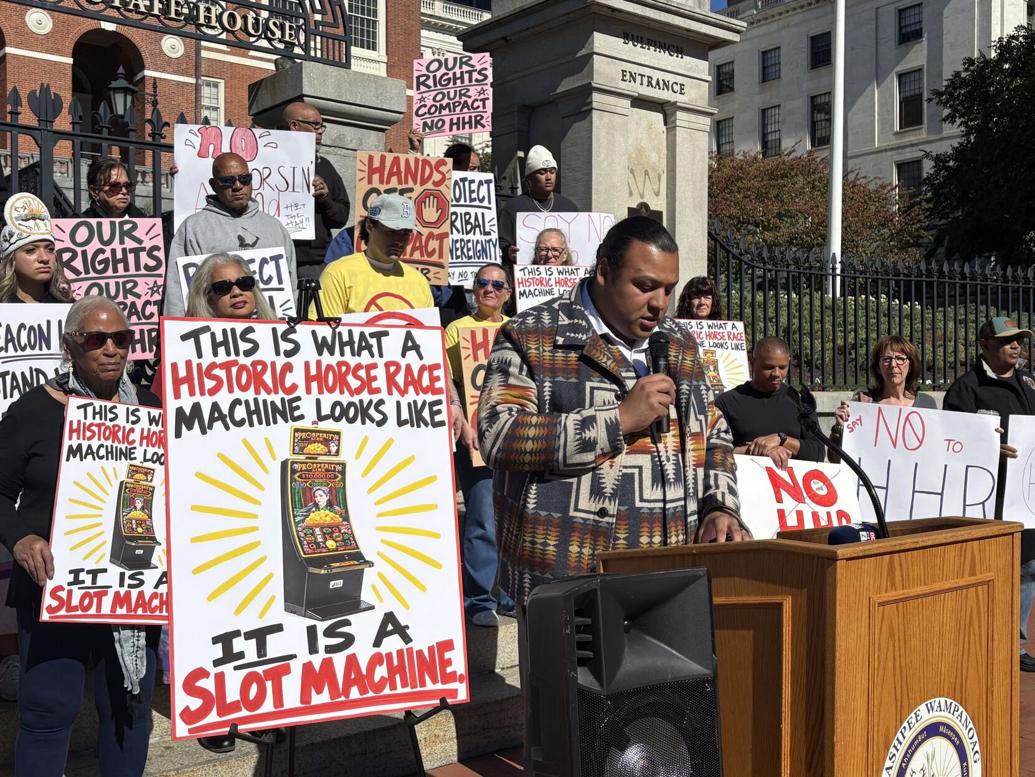
The tribe rallied outside the State House on Thursday to call on lawmakers to scuttle the House plan. Chairman Brian Weeden said historical horse racing “threatens our tribal sovereignty and the economic future of our tribal community.”
“Anyone with eyes who cares to see would understand that these HHR machines are simply slot machines with a different name,” Weeden said. “We fought for years to secure our reservation lands, negotiated in good faith with the commonwealth concerning our gaming facility, and responsibly planned for our gaming facility’s future. Now the commonwealth is considering a proposal that would circumvent those laws and dramatically expand gaming without the protections and oversight that apply to everyone else.”
The tribe operates the First Light Casino in Taunton, a slots facility that sits outside the Gaming Commission’s jurisdiction, and signed a gaming compact with the state in 2013. Weeden said Thursday the facility opened about a year and a half ago with 10 machines and has grown since to 250 machines.
“The plan is to keep on growing and expanding, to build out,” he said. “The tribe is actually finally bringing in income, not relying on investors or anything else, grants, things like that that are drying up as well.”
Developer Richard Fields, who as an owner of Suffolk Downs was unsuccessful in his attempt to secure the Boston-region casino license for that location, is behind the push for HHR and reportedly has a deal in place to buy the Raynham facility should the state authorize the machines. He told the Boston Globe in July that a report he commissioned suggested his idea could lead to $150 million in new construction at Suffolk Downs and $75 million in renovations at the former Raynham Park, with nearly 1,200 new jobs.
The House amendment would direct tax revenue from HHR gaming to the Health Safety Net Trust Fund, which reimburses hospitals and community health centers for care delivered to low-income uninsured and underinsured patients.
“This legislation is designed to preserve and support an industry that sustains economic activity and hundreds of jobs across Massachusetts. HHR will create new economic opportunities in the Raynham-Taunton region and generate over $100 million annually for Massachusetts safety net hospitals, including NeighborHealth in East Boston,” said Sterling Suffolk Racecourse, which controls the Suffolk Downs simulcast license but says it is exploring moving the facility to another location within Suffolk County. “We appreciate the thoughtful consideration of policymakers and recognize the continued leadership on this important issue.”
There was no discussion or debate of the idea before representatives unanimously approved it as part of a mega-amendment tacked onto a sweeping economic development bill. Republican Rep. David Vieira of Falmouth said at the tribe’s rally Thursday that he and others learned only after the amendment passed what its ramification could be.
“There wasn’t the transparency, either on the floor or off the floor with the general membership. And it was after conversations with the [tribal] chairman that we began to unpack what had happened there, and then began reaching out to the Senate colleagues to say, ‘This cannot stand in the Senate,'” he said.
The Senate did not include the authorization in its version of the economic development bill, but also rejected an amendment to explicitly forbid betting on historical horse races. The gaming expansion is one of several policies said to be under negotiation between three representatives and three senators since late July.
“I think there’s a series of policy issues that have drawn out the decision, this being one of those main situations,” Vieira, who is not on the conference committee, told the News Service on Thursday.
Fresh opposition to HHR also came Thursday from Wynn Resorts CEO Craig Billings, who wrote an op-ed in the Boston Globe arguing that Massachusetts is “steadily undermining” the limited-license model that casinos bought into more than a decade ago here. He said sports betting and online Lottery sales have already ratcheted up the competition for traditional gambling centers, which are also sweating possible competition from HHR and online casino gambling.
“As technology has introduced new gaming platforms, Massachusetts policy makers have embraced them while largely ignoring their impacts on existing employees, employers, and future investments,” Billings wrote. He added, “Massachusetts has benefited enormously from the casino framework it established in 2011. But that framework depends on policy stability. If the Commonwealth wants the jobs, tax revenue, community payments, and private investment destination resort casinos generate, it must also accept responsibility for the policies that determine whether those outcomes remain sustainable.”
Colin Young is the deputy editor for State House News Service and State Affairs Pro Massachusetts. Reach him at colin.young@statehousenews.com.