
Editor’s Note: This article, written in the throes of the 1983 Boston mayoral campaign, appeared in the June 27 issue of the Boston Ledger, a weekly newspaper. At the time ethnic politics played a greater role than it does today. The 1983 mayoral campaign was a transformational one for the city of Boston.
Winning the Hearts and Votes of Italians
By Frank Conte
It’s no mystery where Boston’s Italian-American vote has been going for the past 16 years, but now that Kevin White is leaving office, the city’s second largest ethnic group is once again up for grabs. Pollsters and pundits alike are hard-pressed to say what will happen as a result.
For many Italian-Americans, the 1983 election will be a test of whether or not one of “their own” can finally accede to an office which historically has eluded them.
Complicating any attempts to measure the impact of the Italian-American vote is the presence in the mayoral race of two Italian-surnamed candidates, former City Councilor Lawrence DiCara and City Councilor Fred Langone.
Meanwhile, Dennis Kearney, whose wife Bernadette is from a family with roots in the North End, stands to take hold of a solid bloc of Italian votes in his hometown of East Boston, where State Rep. Emmanuel “Gus” Serra is expected to grant an endorsement.
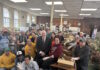
“The Italians vote for the man and they usually go for the hometown candidate,” boasted Kearney at a recent fundraiser for a local district school committee candidate. Kearney, who once worked in the Little City Hall program, has established a durable organization in East Boston, which he maintains has the third largest voter turnout in the city.
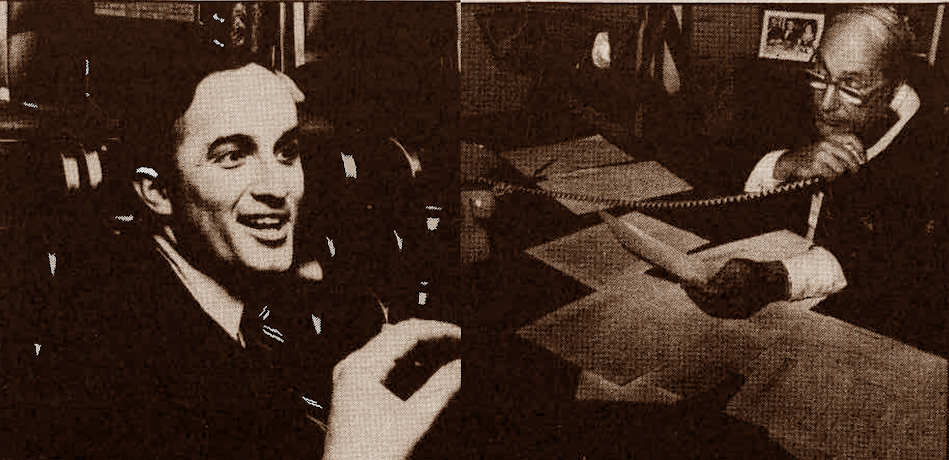
“The Italians are gallant,” sociologist Rocco Caporale told Stephen Hall of the New York Times Magazine recently. “They give away their votes. We come from a country that is terribly divided, distrustful of others — it has been a hallmark for centuries and continues today.”
In his recent article, Hall writes that Italian-Americans lack a common political ground. “Italian-American politics reveals itself as a paradoxical world where there is no single issue (such as Israel for the Jews) that holds them together and where blood does not always speak of other candidates.”
On the national level, Italian-Americans are no less nomadic politically. According to polls, they supported Ronald Reagan by a healthy margin. Two years later they helped sweep liberal Democrat Mario Cuomo to victory in the New York gubernatorial election.
In Boston, where ethnic politics is the norm, the Italians have never been able to settle on a candidate that could appeal to a coalition of voters, despite having been one of the fastest growing of Boston’s ethnic groups in the early 1900s. At the turn of the century there were only 14,000 Italians living in Boston.
Today there are roughly 50,000 Italians living in the city.
Despite the impressiveness of the statistics, the Italians have always trailed behind the Irish in climbing the political ladder. According to Arthur Rolle, who has studied their rise, compared to other groups Italians were less active politically. Ward bosses arose from within the Irish-American community, while Italians were appeased with jobs. “Wherever possible,” wrote Rolle, “ethnic politicos who could deliver bloc votes saw to it that patronage jobs filtered down to the Italian community.”
DiCara historically has done well among Italian voters in City Council elections, but to win the mayoral election DiCara must put together a coalition including blacks, young professionals, business leaders, liberals, and Italians. He knows that getting his share of the Italian vote is going to be difficult. But DiCara, who was raised in Dorchester, has only lightly campaigned in the Italian-American wards. When he made his first campaign stop in East Boston few supporters showed up. On Langone’s North End turf DiCara has yet to set up a local organization. His sole outreach has been through the pages of the Post-Gazette, which has been publishing his press releases.
Langone has been the strongest vote-getter in Italian wards, topping the tickets in wards 1 and 3 in past City Council races. Langone has forged a solid relationship with Italian-American voters.
Langone, who is a frequent presence at public hearings, funerals, and baptisms in the Italian neighborhoods, knows his strengths.
“Some of you fellows in the big media are trying to keep me down,” he said. “People believe me but I have to be ridiculed by the press.”
Langone denies persistent rumors that he is in the race to hurt fellow Italian DiCara and native son Kearney. “That’s typical of the fourth estate,” he remarked. “I’m not out to hurt a Kearney or a DiCara. If that’s the kind of stories they want to spread then that’s bull.”
“Outside of blacks who have a vested interest for voting for one of their own, I don’t think anybody votes as a bloc,” said David Finnegan’s press secretary Listo Fisher. Fisher said Finnegan will try to broaden his appeal for the Italian vote.
Strategists for Ray Flynn intend to run an issue-oriented campaign in the Italian wards. “I think his support goes beyond the ethnic wards and into the issues that affect communities like East Boston,” said Alan Stern, a pollster for Flynn.
Robert Kiley, Melvin King, Eloise Linger, Jon Straight and Michael Gelber will have a difficult time capturing first or second place in the Italian wards, virtually all election head-counters agree.
Kiley, who is usually perceived as a Beacon Hill liberal out of touch with street politics, has yet to set up organization. King, who barely managed to receive 262 votes in Ward 1 in 1979, is seeking to make inroads. Recently, at a poorly attended house party, King said he would campaign in East Boston with more vigor. “I expect to get 1,000 votes in East Boston,” he added. Others say that will be a tall order to fill.
State Rep. Sal DiMasi (D–North End) contends that Italian-Americans could make the difference in the mayoral race if they translated some of their social strengths into political ones. “We should project our political unity as we do our family unity,” he remarked. The candidate who can convince Italian-American voters of that just might make a surprising finish in the 1983 election.